Toward the Decarbonization of Ammonia Production through the Gradual Incorporation of Green Hydrogen
Abstract
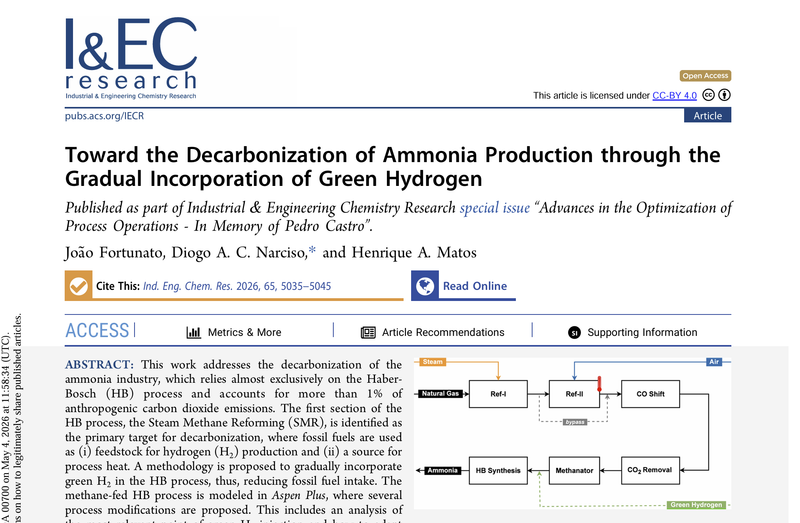
This work addresses the decarbonization of the ammonia industry, which relies almost exclusively on the Haber-Bosch (HB) process and accounts for more than 1% of anthropogenic carbon dioxide emissions. The first section of the HB process, the Steam Methane Reforming (SMR), is identified as the primary target for decarbonization, where fossil fuels are used as (i) feedstock for hydrogen (H2) production and (ii) a source for process heat. A methodology is proposed to gradually incorporate green H2 in the HB process, thus, reducing fossil fuel intake. The methane-fed HB process is modeled in Aspen Plus, where several process modifications are proposed. This includes an analysis of the most relevant point of green H2 injection and how to adapt plant operation to satisfy all process constraints, while minimizing methane consumption. The process limitations that are subject to this operation strategy were identified by increasing the green H2 incorporation fraction. The main bottleneck of this strategy relates to SMR operation, namely the increase in the secondary reformer’s outlet temperature. A partial bypass of the primary reformer is suggested to prevent this unit from overheating. This additional modification proved effective in controlling the temperature, enabling green H2 incorporation of up to 60% while satisfying all process constraints.
Subjects:
Ammonia, Natural resources, Redox reactions, Thermodynamic properties